Asian stock markets fell sharply following a severe rout in the U.S., with declines deepening from a day earlier. The Nikkei 225 is off 5.26% while the Hang Seng is down 4.31%. The Shanghai Composite is trading down by 2.1%.
The Dow Jones industrial average plunged by 1,175 points, its largest single-day points drop in history.
In the biggest global sell-off since 2016, financial markets from Asia to Europe to the United States were rocked primarily by concerns about inflation. The Dow was off a heart-stopping 1,600 points during afternoon trading, the largest intraday point decline in the blue-chip index’s history.
The Dow’s dive erased gains for the year so far and extended a multi-day slump that saw the Dow drop by some 600 point.
While market fear may not be based in any change in economic fundamentals, in its last meeting under chair Yellen, the Federal Reserve indicated it expects inflation pressures to increase through the year.
According to projections released in December, officials expect three rate hikes in 2018 — so long as market conditions remain broadly as they are — but some economists believe the central bank could add another increase at its final meeting of the year.
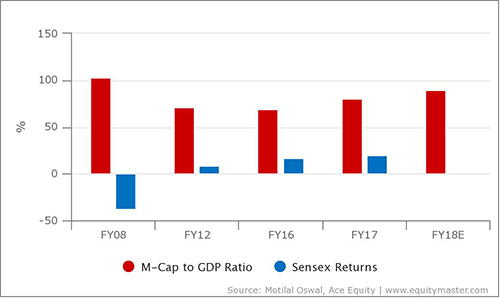
The Market cap to GDP ratio for Indian companies is close to dangerously high levels. While this is still some way off the peak of FY-08, when it had once reached close to 150, it’s relatively high.
FY17 saw this ratio reach close to 80. It is also expected to increase further given the moderate growth expectations in India’s GDP for FY18. Warren Buffett once considered this as one of the best valuation metrics to gauge the markets.
The Warren Buffett Indicator Suggests Indian Equity Market Is Overvalued
Past history shows some correlation between the ratio and the share market. 2008 saw Sensex decline by 38%, when this ratio crossed the 100 mark. Also, the market has bounced back sharply when this ratio was low.
The basic assumption in this ratio is that whenever the GDP of the country grows, the market performance will reflect it. Also, when stocks do well, it can be extrapolated to assume the Indian economy is doing well.
In news from automobile sector, Tata Motors’ third quarter consolidated earnings missed analyst expectations on Monday due to weak Jaguar Land Rover show; but standalone or domestic business reported healthy performance backed by strong commercial vehicle segment performance and cost reduction efforts.
Net profit rose to Rs 12.14 billion for the three months ended December from Rs 1.11 billion in the same period a year earlier, the biggest jump in seven quarters.
Sales in JLR unit rose just 3.45% from a year ago to 154,447 units. While sales in the US and Europe declined, sales growth in China slowed to 14.6%. JLR’s sales were weighed by few launches and model refreshes during the year. The company expects to maintain an Ebitda margin of 8–10% in the medium term.
Tata Motors’ passenger and commercial vehicle business performance was strong for the quarter as standalone profit stood at Rs 1.83 billion in Q3 against loss of Rs 10.45 billion in same period last year.
In another development, Tata Motors Ltd and Warburg Pincus Llc have mutually agreed to call off the US private equity firm’s proposed investment of around US$360 million in Tata Technologies Ltd.
Due to delays in securing regulatory approvals as well as due to the recent performance of the company not meeting internal thresholds because of market challenges, the parties mutually decided not to proceed.
Moving on to news from telecom sector. As per a leading financial daily, Singapore Telecommunications Ltd (Singtel) will indirectly raise its stake in Bharti Airtel Ltd by investing Rs 26.49 billion in Bharti Telecom Ltd, the promoter company of Airtel, through a preferential allotment of shares.
With this investment, Singtel’s total stake (along with its affiliates) in Bharti Telecom will increase to 48.9%. Singtel currently holds 47.17% stake in Bharti Telecom. Bharti Enterprises continues to hold over 50% stake in Bharti Telecom.
The investment comes within 23 months of Singtel’s participation in Bharti Telecom’s Right Issue of Rs 25 billion, which was completed in February 2016.
Bharti Airtel’s quarterly profit for the December quarter plunged 39% to Rs 3.06 billion, as India’s telecom regulator more than halved interconnection fees and a pricing war triggered by the entry of Reliance Jio Infocomm continued unabated.
Airtel’s net debt as of 31 December was Rs 917.13 billion, up from Rs 914.80 billion as of 30 September.
After opening the day on a negative note, Indian share markets have continued the downtrend and are currently trading in red. Sectoral indices are trading mixed, with stocks in the capital goods sector and stocks in the banking sector witnessing maximum selling pressure.
The BSE Sensex is trading down by 310 points (down 0.9%) and the NSE Nifty is trading down 94 points (down 0.9%). Meanwhile, the BSE Mid Cap index is trading down by 0.6%, while the BSE Small Cap index is trading down by 0.7%. The rupee is trading at 64.11 to the US$.
In news from stocks in the telecom sector. Bharti Airtel share price is among the top gainers on the bourses today. The surge came after, the country’s largest telecom company said that Singapore Telecommunications Ltd (Singtel) will increase its stake in Bharti Airtel, by investing Rs 26.5 billion in parent Bharti Telecom.
The stake will be increased by a preferential allotment of shares to Singtel, and the proceeds will be used to reduce the debt of the company.
As of December 2017, Airtel’s consolidated debt stood at Rs 917 billion.
Singtel will be allotted up to 8.5 million equity shares at an issue price of Rs 310 per equity share.
With this investment through its wholly-owned subsidiary, Singtel’s total stake (along with its affiliates) in Bharti Telecom will increase to 48.9%, from 47.17%. Consequently, Singtel’s economic interest in Bharti Airtel will rise by 0.9% to 39.5%.The transaction, which is subject to the shareholders’ approval of Bharti Telecom, is expected to be completed by March 2018. Bharti Enterprises continues to hold over 50% stake in Bharti Telecom.
Singtel’s investment comes at a time when the telecom sector is going through a slump.
Telecom Sector: A decade of Underperformance
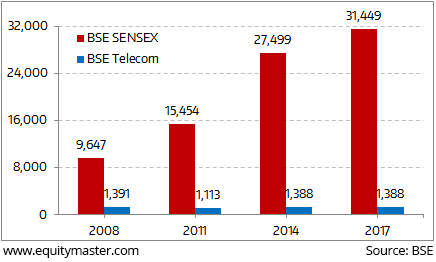
The whole telecom business has been an underwhelming story so far. While the telecom subscriber base has increased from 300 million in 2008 to 1.2 billion in 2017, investors have little to cheer. The BSE Sensex has gone up 3.25 times in nine years, but the BSE Telecom Index has not moved an inch from its levels of 2008.
With the entry of Reliance Jio, the competition has intensified further. Reliance Jio’s low cost offerings and strategy of capturing market share will further dent the sector. The sector has been a classic ‘value trap’. While it always looks cheap compared to other sectors, it has failed to provide any reasonable returns. We also believe the situation is unlikely to change in the near future. For an investor, it’s important to differentiate between ‘value’ and ‘value traps’.
At the time of writing, Bharti Airtel share price was trading up by 4.4%.
According to a leading financial daily, M&M has sought board approval to invest about Rs 8 billion to develop two new electric vehicle (EV) products and set up a research and development Centre for such vehicles.
M&M, which has so far invested Rs 6 billion in its electric venture, plans to raise EV capacity to 1000 units a month by end-2018 from about 200 units now, and 5,000 by 2020. If everything goes as planned, M&M could be selling 60,000 EVs annually by 2020, and if that makes up a quarter of the market, that would mean a total EV market size of 250,000.
Currently, electric vehicle sales are low in India, rising 37.5% to 22,000 units in the year ended 31 March 2016 from 16,000 in 2014–15. Only 2,000 of these were cars and other four-wheelers, according to automobile lobby group Society of Indian Automobile Manufacturers (Siam).
The government wants to see 6 million electric and hybrid vehicles on Indian roads by 2020 under the National Electric Mobility Mission Plan 2020.
The government is targeting to have all cars propelled by electric engine by 2030. The target is more daunting than in many advanced countries.
According to the industry, the 2030 target would require eight to ten times the global stock of such vehicles. India would need to sell more than 10 million electric cars in 2030, compared to 5,000 electric vehicles India had on the road in 2016.
Another issue is the price of the lithium ion battery, which constitutes 30% to 40% of the cost of the car. For this plan to succeed, the price of the battery needs to come down.
The auto industry is already facing regulatory headwinds. The shift from BS-IV emission norms to BS-VI has been two years ahead of schedule without an intermediate stage. The government, if it is serious about such ambitious targets, should offer the necessary infrastructure support and do its bit for a smooth transition.
At the time of writing, M&M share price was trading down by 1%.
The BSE Sensex is trading down 245 points (down 0.7%) and the NSE Nifty is trading down 81 points (down 0.8%). The BSE Mid Cap index is trading down by 0.9%, while the BSE Small Cap index is trading down by 1.2%. The rupee is trading at 64.01 to the US dollar.
In the news from macroeconomic space, as per an article in the Economic Times, the Income Tax (IT) department has issued a set of FAQs to clear doubts about the long-term capital gains tax levied on shares in the Budget, clearly providing that the tax will be levied on shares sold after 1st April 2018.
In the Union Budget 2018 announced last week, Finance Minister Jaitley announced a long-term capital gains tax of 10% on sales of listed securities on gains over Rs 1 lakh. This came in as a surprise for the market. The market at the worse was expecting a change in the definition of long term capital gains.
Currently, sale of listed securities beyond a period of one year are exempt from taxation. The market was expecting this period of one year to be extended to two or three years.
However, as per the current proposal if you sell your equity within the period of one year, you would have to pay the usual 15% short term capital gain on your gains. For period beyond one year, you will have to pay a long-term capital gain of 10% without the benefit of indexation.
Nevertheless, the tax imposed is still lower than the short-term capital gains tax and a third of what you would pay if your earnings are in the highest tax bracket from any or all other sources.
Also, with the “grandfathering” that the government has allowed, the new levy should hurt less than previously thought. Put simply, this means there is no retrospective taxation.
For example, if an equity share is purchased six months before January 31, 2018 at Rs 100 and the highest price quoted on January 31, 2018 for this share is Rs 120, there will be no tax on the gain of Rs 20 if this share is sold after one year from the date of purchase.
However, any gain in excess of Rs 20 earned after 31st January, 2018 will be taxed at 10% if this share is sold after 31st July, 2018.
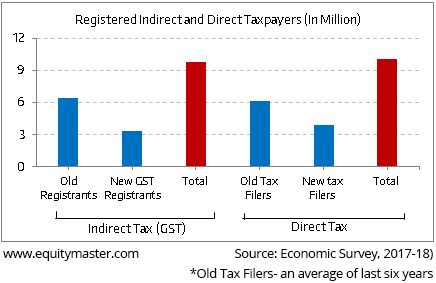
Speaking of taxation, one should note that there has been a large increase in registered indirect and direct taxpayers lately, as can be seen from the chart below:
A Large Increase in Registered Indirect and Direct Taxpayers
Since the launch of Goods and Services Tax (GST), there were 9.8 million unique GST registrants, an increase of 50% compared to the previous tax regime. There has also been a large increase in voluntary registrations, especially by small enterprises that buy from large enterprises wanting to avail themselves of input tax credits.
Similarly, after November 2016, 10.1 million tax filers were added compared to an average of 6.2 million in the preceding six years. Further analysis suggests that new filers reported an average income, in many cases, close to the income tax threshold of Rs. 2.5 lakh, limiting the early revenue impact. As income growth pushes many of the new tax filers in time over the threshold, the revenue dividends should increase robustly.
These changes can have profound effect on the Indian economy. With the increasing tax base, the government will have a significant amount of resources to spend on infrastructure, health and education, While the fiscal deficit will be stable.
As organized players gain market share, it will begin to reflect in corporate earnings and stock prices too.
In the news from currency markets, the dollar is witnessing buying interest today. Gains are seen as the currency rallied on upbeat US jobs data, which sent bond yields surging on the prospects of increasing inflation and hammered equities.
The dollar index against a basket of six major currencies gained on Friday, when the US payrolls report showed wages growing at their fastest pace in more than 8 years and fueling inflation expectations. It has continued the uptrend this week as well.
To keep a tab on the movements in the dollar and other currencies, you can read the stock market commentary from the Daily Profit Hunter team. Their commentary tracks the developments in the global economy as well as stock, currency, and commodity markets.
Asian stocks are lower today following a sharp decline in US stocks on Friday amid a stronger-than-expected jobs report that sent interest rates higher. The Shanghai Composite is off 0.30% while the Hang Seng is down 1.85%. The Nikkei 225 is trading down by 2.49%. US stocks slumped on Friday with the Dow Jones Industrials Average swooning almost 666 points, for its biggest daily percentage loss in 20 months.
Back home, India share markets opened sharply lower amid worries over rising revenue and fiscal deficits as well as weak cues from Wall Street and Asia. The BSE Sensex is trading lower by 409 points while the NSE Nifty is trading lower by 139 points. The BSE Mid Cap index and BSE Small Cap index opened the day down by 2.6% & 2.7% respectively.
All sectoral indices have opened the day in red with metal stocks and realty stocks witnessing maximum selling pressure. The rupee is trading at 64.08 to the US$.
In latest development. Foreign investors have pumped in a whopping US$3.5 billion (over Rs 220 billion) into the country’s capital markets in January in anticipation of better corporate earnings and attractive yields.
According to the depositories data, Foreign Portfolio Investors (FPIs) infused a net amount of Rs 137.8 billion in equities and Rs 84.7 billion in debt in January — translating into net inflows of Rs 222.5 billion (US$3.5 billion).
This comes following an outflow of over Rs 35 billion by FPIs from the capital markets (equity and debt) in December, the reports noted.
A slew of factors such as positive global markets; promising economic numbers back home; better than expected third quarter earnings and IMF’s projection to retain the fastest growing economy tag on India in 2018–19 created a favourable investment environment for FPIs.
In the entire 2017, FPIs put in a total Rs 2 trillion in equity and debt markets.
Notably, finance Minister Arun Jaitley, in his Budget for 2018–19 introduced 10% tax on long-term capital gains, exceeding Rs 0.1 million, made in the share market.
Also, 10% tax has been levied on distributed income by equity-oriented mutual funds.
Speaking of Union budget 2018–19, The government missed its fiscal deficit target for FY18 by 30 basis points. Against a target of 3.2%, the government managed to keep fiscal deficit at 3.5% in FY18.
It has also outlined the projected fiscal deficit target of 3.3% in FY19 in its budget.
Steady Decline in Fiscal Deficit Over the Years
Maintaining this deficit target in FY19 won’t be easy.
In the past, the government has relied on reducing expenditure to keep the fiscal deficit in check.
For the next year, the government is banking on earning much more than it has in the past. It expects a major portion of the revenue to be collected through GST tax collections. Also, the recent rise in crude oil prices has cast a doubt over how much the government will be to curb its spending. It also needs to revive the economy from the shock of Notebandi.
The dual pressure of increasing expenditure and lower inflows makes this FY19 deficit target an uphill challenge.
Moving on to the news from oil & gas sector. As per an article in a leading financial daily, GAIL (India) Limited has placed order of Rs 4.4 billion for laying of approximatley 350 kms of pipeline from Vijaipur (in the state of Madhya Pradesh) to Auraiya (in the state of Uttar Pradesh).
This is a part of approximately 665 km length from Vijaipur to Phulpur to the existing HVJ-DVPL upgradation pipeline system. The pipeline laying contracts for 315 km stretch from Auraiya to Phulpur was earlier awarded during November 2016.
Reportedly, this pipeline shall provide the gas feed to the ongoing 2,655 Km long Jagdispur-Haldia-Bokaro-Dhamra pipeline (JHBDPL) project of GAIL.
The JHBDPL will pass through the state of Uttar Pradesh, Bihar, Jharkhand, West Bengal and Odisha, and the project is progressing in full swing which will usher Industrial development in East India by supplying environmentally clean Natural Gas to Fertilizer and Power plant, Refineries, Steel plants, City Gas Distribution and other Industries.
One shall note that, GAIL has awarded contracts of Rs 54 billion in the current fiscal year which includes Rs 35 billion for procurement of pipeline and Rs 19 billion for laying of pipes.
Further, GAIL has awarded till date contracts worth Rs 75 billion for ongoing pipeline projects of around 4,000 kms in south and eastern India.
It has been a rocky week for global financial markets. World stock markets declined this week as a jump in global borrowing costs cooled the year’s euphoric start in financial markets.
On Wednesday, the Federal Reserve held interest rates steady but indicated a more hawkish inflation outlook. US Treasury yield rose further after economic indicators seemed to confirm the Fed’s inflation outlook. The Dow Jones Industrial Average plunged 4.1% this week fuelled by inflation concerns and political tensions.
The European stocks started the month on a dismal note. European shares suffered their biggest weekly loss in more than a year on Friday as investors’ appetite for risk dried up. The euro and the British pound strengthened further against the dollar, putting additional pressure on stocks of European exporters. German and French markets were down by 4.2% and 3% respectively this week, while the UK’s FTSE plunged 2.9%.
Investor sentiment in Asia was hit by concerns about rising interest rates. In China, profit booking ahead of the Lunar New Year holidays in mid-February led to a correction. China’s Shanghai Composite fell 2.7% over the week. Japan’s Nikkei, a major underperformer in the past couple of weeks, was down by 1.5% this week.
Back home, the Union Budget triggered huge volatility in the stock markets. Indian share markets slumped 800 points on Friday as market participants were disappointed with the government’s Union Budget for the fiscal year 2018–19. The Finance Minister in his Budget speech announced a 10% levy on capital gains of over Rs 1 lakh without the benefit of indexing. The government’s move to bring back long-term capital gains tax on equities and retain securities transaction tax (STT) has raised questions in many quarters.
BSE-Sensex ended the week on a negative note and plunged 2.7% to 35,067, while the Nifty 50 slumped 2.8%, to 10,761 this week. Meanwhile, the BSE MidCap was down 7.1% and BSE SmallCap declined 7.7% this week.
Key World Markets During the Week
On the sectoral indices front, stocks from Consumer Durables and Realty witnessed selling pressure.
BSE Indices During the Week
Now let us discuss some key economic and industry developments during the week gone by.
The Finance Minister tabled the Union Budget 2018–19 on Thursday. This was the last full budget of the current government.
The Finance Minister revised his fiscal deficit target for 2018–19 to 3.3% of the gross domestic product (GDP) against the earlier target of 3%, after breaching the deficit target for 2017–18. While the budget estimate of the fiscal deficit for 2017–18 was 3.2% of the GDP, the revised estimate is now 3.5% of the GDP, the same as 2016–17. The government hopes to breach the disinvestment target in 2017–18 by collecting Rs 1 trillion against the budget estimate of Rs 725 billion. For 2018–19, the government has set a disinvestment target of Rs 800 billion, including gains from privatization of Air India Ltd.
The budget focused mainly on agriculture and rural sectors, along with the creation of the world’s largest National Health Protection program, that would reach up to 10 crore poor families. Budget reduced the tax rate to 25% for companies who have a reported turnover of up to Rs 2.5 billion. This will benefit the entire MSME sector, which accounts for 99% of the companies filing their tax returns. Revenue foregone is Rs 70 billion.
The finance minister also announced that three public sector insurance companies-The Oriental Insurance Company Ltd, National Insurance Company Ltd, United India Insurance Company Ltd- will be merged into a single insurance company and listed on the exchanges. In addition, the finance minister announced a slew of reforms for the infrastructure sector, to spur growth and employment.
In news from the economy, as per an article in The Business Standard, India’s annual budget could push up inflation and prompt the central bank to raise interest rates sooner raising the probability of a scenario that could hurt the nascent economic recovery. Jaitley raised government spending for rural areas and support to farmers while slowing the pace of fiscal consolidation.
Traders and analysts believed these moves could add to inflationary pressures at a time when retail inflation is at a 17-month high. That would make the Reserve Bank of India more cautious when it announces the monetary policy review on Wednesday next week. A cautious stance at the RBI would increase the probability of interest rate increases in the coming fiscal year. That, in turn, could raise tensions between the government and the central bank, which has resisted pressures for deep rate cuts to boost growth as it worried about increasing inflation.
Moving on to news from the GST space. The government postponed the implementation of the e-way bill requirement for movement of consignments in the goods and services tax (GST) regime after technical glitches led to disruption in trade. The e-way bill, an electronic documentation tracking the movement of goods, was mandatory for all inter-state movement of goods from 1 February.
The GST Council had mandated that E-way bill for inter-state movement of goods will come into force from February 1, and states would have time till June 1 to move ahead with intra-state E-way bill.
However, more than 16 states decided to implement it from 1 February itself, leading to technical glitches. Businesses had two weeks trial time before the system was due for rollout in February, but policymakers chose to defer implementation to avert technical glitches causing disruption in the supply chain at a time GST revenue has started stabilising. Once implemented, e-way bill is needed for all movement of goods valued at more than Rs 50,000. within or outside a state.
Movers and shakers during the week
Source: Equitymaster
Some of the key corporate developments in the week gone by.
In news from stocks in the FMCG sector. Dabur and Marico were in focus this week amid a legal battle brewing between them both. Dabur took rival Marico to the Delhi High Court for allegedly violating trademark and copyright laws by comparing their hair oil products and denigrating its Dabur Amla in a print advertisement.
The court issued a notice to Marico and scheduled the next hearing for February 7, the person said. News reports said Marico ran print ads last week that used pictures of Dabur Amla hair oil and compared it with its Nihar Shanti Amla hair oil. Mumbai-based Marico’s consumer products include Parachute, Saffola, Nihar Naturals, Livon, Set Wet, Mediker and Revive. Dabur has a portfolio of over 250 herbal and Ayurvedic products. It would be interesting to see where the legal battle heads in the days to come.
Moving on to the news from the banking sector. ICICI Bank announced its third quarter results this week. The bank reported a 32% drop in its profits for the third quarter ended 31 December 2017 to Rs 16.5 billion. Net interest income for the quarter rose 6%, while non-interest income was down 20%. Profits in the first two-quarters of the fiscal were slightly above the Rs 20-billion mark.
On a consolidated basis, taking into account the performance of its subsidiaries, profit for the quarter was at Rs 18.9 billion, compared to Rs 26.1 billion in the corresponding quarter of the previous year. Further, additions to the gross non-performing assets were at Rs 43.8 billion during the quarter, substantially lower than the Rs 70.4 billion added in the same quarter of the previous fiscal. Gross NPAs for the bank were at Rs 460.4 billion at the end of December 2017 and were at 7.8% of loans. Provisions declined sequentially to Rs 35.7 billion, from Rs 45 billion in the previous quarter. Provision coverage increased to nearly 61%. Meanwhile, domestic loan growth for the bank picked up speed during the quarter, growing at 16% year-on-year, propelled by retail loans which grew faster at 22% YoY.
State Bank of India (SBI) has raised the interest rates offered on bulk deposits above Rs 10 million by 50–140 basis points. Thus, indicating the possibility of a spike in interest rates in the banking system. While the hike has come a week before the Reserve Bank of India is to announce monetary policy, it has not made any changes in the deposit rates offered to retail investors.
Reportedly, the rise in bond yields and the bulk deposit rates has spurred expectations that the Reserve Bank will tighten rates and the government will go for a wider deficit. The bank would offer 6.25% on bulk deposits for one year, a rise of 100 basis points, with immediate effect. The bank has sharply raised rates for 46–210 days by 140 basis points from 4.85% from 6.25%.
With this, bulk deposit rates have been aligned with the retail rates below Rs 10 million. It will offer 5.25% for deposits between seven days to 46 days, a hike of 50 basis points. It would offer 6.25% for all deposits in the range of 46 days to 2 years and 6% for deposits between two years to 10 years.
Moving on to news from the automobile sector. As per an article in The Livemint, Mahindra and Mahindra Ltd (M&M) is planning to start a business that will operate a fleet of electric cars and turn its electric vehicle (EV) manufacturing unit into a supplier of parts to EV makers. The company plans to turn its unit Mahindra Electric Mobility Ltd into a supplier of batteries, starter motors, power electronics and transmission to its parent and other vehicle makers.
Also, it was recently reported that Maruti Suzuki is looking for lithium suppliers for a battery plant in Gujarat, planning to build a brand new electric car for India and working with its dealers to set up vehicle charging networks as part of its initiative to build an electric car business portfolio. As the momentum in favour of vehicles running on green technologies such as electricity gathers pace, the traditional business models of the automotive industry are expected to change.
Moving on to the news from pharma sector. As per an article in a leading financial daily, Lupin has received a final nod from the US health regulator to market its Clobetasol Propionate cream used for the treatment of various skin conditions. The United States Food and Drug Administration (USFDA) granted the final approval to market its generic Clobetasol Propionate cream USP, 0.05%. The company’s product is a generic version of Fougera Pharmaceuticals Inc’s Temovate cream.
And here’s an update from our friends at Daily Profit Hunter…
The Nifty 50 Index witnessed extreme selling pressure this week. It started the week on a positive note with the index rallying 60 points to touch a new life-time high. But the buying was temporary, and it slipped 80 points on the very next day.
The pressure continued until Thursday where the index witnessed wild swings as the Finance Minister presented the FY19 Union budget. Finally, on Friday, the bears continue to dominate, as the index fell 256 points in a single day to end the weekly session nearly 2.80% lower.
Last week, we mention that the RSI indicator was in its extreme overbought territory. This called for a correction and as a result the index slipped more than 300 points in a single week. If the index keeps dropping, what happens at the 10,500 level, which is an important support, would an interesting level to watch out for.
So will the index correct to 10,500 level or will it resume it up move from here itself?
After opening their day in red, share markets in India continued their downtrend and ended today’s trading session deep in the red. Losses were seen across all sectors with stocks in the realty sector and stocks in the power sector leading the losses.
At the closing bell, the BSE Sensex stood lower by 840 points (down 2.3%) and the NSE Nifty closed down by 256 points (down 2.3%). The BSE Mid Cap index ended the day down 4%, while the BSE Small Cap index ended the day down by 4.7%.
Asian stock markets too, finished in red. As of the most recent closing prices, the Hang Seng was down by 0.12% and the Nikkei 225 was down by 0.90%. Meanwhile, European markets were also trading in the red. The FTSE was down by 0.34%. The DAX stood was down by 1.57%, while the CAC 40 was down by 1.36%.
The rupee was trading at Rs 64.00 against the US$ in the afternoon session.
In the Union Budget 2018 announced yesterday, Finance Minister Jaitley announced a long-term capital gains tax of 10% on sales of listed securities on gains over Rs 1 lakh. This came in as a surprise for the market. The market at the worse was expecting a change in the definition of long term capital gains.
Currently, sale of listed securities beyond a period of one year are exempt from taxation. The market was expecting this period of one year to be extended to two or three years.
However, as per the current proposal if you sell your equity within the period of one year, you would have to pay the usual 15% short term capital gain on your gains. For period beyond one year, you will have to pay a long-term capital gain of 10% without the benefit of indexation.
Nevertheless, the tax imposed is still lower than the short-term capital gains tax and a third of what you would pay if your earnings are in the highest tax bracket from any or all other sources.
Also, with the “grandfathering” that the government has allowed, the new levy should hurt less than previously thought. Put simply, this means there is no retrospective taxation.
For example, if an equity share is purchased six months before January 31, 2018 at Rs 100 and the highest price quoted on January 31, 2018 for this share is Rs 120, there will be no tax on the gain of Rs 20 if this share is sold after one year from the date of purchase.
However, any gain in excess of Rs 20 earned after 31st January, 2018 will be taxed at 10% if this share is sold after 31st July, 2018.
The tax slab remains unchanged. However, Mr Jaitley provided certain deductions which could marginally benefit the salaried individual.
The budget provided a standard deduction of Rs 40,000 for salaried individuals. Standard deduction essentially means that the employee does not require to furnish any investment proofs or bills to claim this deduction of Rs 40,000. However, there is a catch.
Speaking of taxation, one should note that there has been a large increase in registered indirect and direct taxpayers lately, as can be seen from the chart below:
A Large Increase in Registered Indirect and Direct Taxpayers
Since the launch of Goods and Services Tax (GST), there were 9.8 million unique GST registrants, an increase of 50% compared to the previous tax regime. There has also been a large increase in voluntary registrations, especially by small enterprises that buy from large enterprises wanting to avail themselves of input tax credits.
Similarly, after November 2016, 10.1 million tax filers were added compared to an average of 6.2 million in the preceding six years. Further analysis suggests that new filers reported an average income, in many cases, close to the income tax threshold of Rs. 2.5 lakh, limiting the early revenue impact. As income growth pushes many of the new tax filers in time over the threshold, the revenue dividends should increase robustly.
These changes can have profound effects on the Indian economy. With the increasing tax base, the government will have a significant amount of resources to spend on infrastructure, health and education, While the fiscal deficit will be stable.
As organized players gain market share, it will begin to reflect in corporate earnings and stock prices too.
In the news from commodity markets, crude oil witnessed buying interest today. Most of the gains were seen as a survey showed strong compliance with output cuts by OPEC and others including Russia. This also allayed concerns about surging US production and aided crude oil prices.
Fiscal revenues are at risk. Particularly if the government is forced to consider a cut in fuel excise duties due to a rally in oil prices. In recent times, a sharp jump in excise collections has helped indirect tax collections. Any risk to revenues and subsequent threat to the fiscal deficit target at 3.2% of GDP would require tighter spending cuts.
Lastly, low crude prices were a positive growth impetus through higher discretionary incomes for households and lower input costs for manufacturers and farmers. Part of this benefit is likely to be eroded as retail fuel costs rise. As for corporations, expansion in gross margins caused by falling commodity prices is also likely to wane, pressurising profitability.
The Nifty 50 Index witnessed extreme selling pressure this week. It started the week on a positive note with the index rallying 60 points to touch a new life-time high. But the buying was temporary, and it slipped 80 points on the very next day.
The pressure continued until Thursday where the index witnessed wild swings as the Finance Minister presented the FY19 Union budget. Finally, on Friday, the bears continue to dominate, as the index fell 256 points in a single day to end the weekly session nearly 2.80% lower.
Last week, we mention that the RSI indicator was in its extreme overbought territory. This called for a correction and as a result the index slipped more than 300 points in a single week. If the index keeps dropping, what happens at the 10,500 level, which is an important support, would an interesting level to watch out for.
So will the index correct to 10,500 level or will it resume it up move from here itself?
Indian share markets slumped 500 points in morning trade as market participants were disappointed with the government’s Union Budget for fiscal year 2018–19.
The FM in his Budget speech announced a 10% levy on capital gains of over Rs 1 lakh without the benefit of indexing. The government’s move to bring back long-term capital gains tax on equities and retain securities transaction tax (STT) has raised questions in many quarters.
The sentiments also remained negative amid weak Asian markets as concerns over rising bond yields in Asia increased.
The BSE Sensex is trading lower by 532 points and the NSE Nifty is trading lower by 166 points. The BSE Mid Cap index is trading down by 3% while the BSE Small Cap index is trading down by 4%. The rupee is trading at 63.61 to the US$.
The Market cap to GDP ratio for Indian companies is close to dangerously high levels. While this is still some way off the peak of FY-08, when it had once reached close to 150, it’s relatively high.
FY17 saw this ratio reach close to 80. It is also expected to increase further given the moderate growth expectations in India’s GDP for FY18. Warren Buffett once considered this as one of the best valuation metrics to gauge the markets.
Past history shows some correlation between the ratio and the share market. 2008 saw Sensex decline by 38%, when this ratio crossed the 100 mark. Also, the market has bounced back sharply when this ratio was low.
The Warren Buffett Indicator Suggests Indian Equity Market Is Overvalued
The basic assumption in this ratio is that whenever the GDP of the country grows, the market performance will reflect it. Also, when stocks do well, it can be extrapolated to assume the Indian economy is doing well.
In news from the economy, as per an article in The Business Standard, India’s annual budget could push up inflation and prompt the central bank to raise interest rates sooner raising the probability of a scenario that could hurt the nascent economic recovery.
Jaitley raised government spending for rural areas and support to farmers, while slowing the pace of fiscal consolidation.
Traders and analysts believed these moves could add to inflationary pressures at a time when retail inflation is at a 17-month high. That would make the Reserve Bank of India more cautious when it announces the monetary policy review on Wednesday next week.
A cautious stance at the RBI would increase the probability of interest rate increases in the coming fiscal year. That in turn could raise tensions between the government and the central bank, which has resisted pressures for deep rate cuts to boost growth as it worried about increasing inflation. Vakrangee share price brimmed over into the fifth trading session amid reports that the company has come under the market regulator scanner for alleged price and volume manipulation of its own scrip on the BSE and the NSE.
PC Jeweller share price cracked 60% routing a huge chunk of the value from the stock. As per Moneycontrol, the firm last week purchased roughly half a percent stake in the company. On January 25, 2018, the company purchased 2 million shares at Rs 561.71 apiece. This amounted to a stake purchase of Rs 1.12 billion. However, the stock soon recovered from the day’s lows after the company’s management, in an interview allayed investors’ fears. It is currently trading 30% lower.
Cigarette stocks were trading higher in morning trade after no major announcement of excise duty hike on cigarettes in the budget.
After almost six years, there will be no increase in cigarette prices after the Budget with finance minister Arun Jaitley giving a breather to the tobacco industry by not announcing any change in taxation or any anti-tobacco initiatives.
As per an article in The Economic Times, this comes as a big relief to cigarette companies which have seen a staggering 202% tax growth since 2011–12.
Also, ITC in its quarterly earnings release had said that the combined impact of increase in excise duty last year and the revision in GST compensation cess had resulted in an incremental tax burden of over 20% on the company.