Friday, 3 August 2018

Sensex up 300 Points; Jet Airways Tanks 8%

After opening the day in green, share markets in India witnessed positive trading activity throughout the day and are presently trading above the dotted line. Sectoral indices are trading on a positive note with stocks in the banking sector and stocks in the pharma sector leading the gains.
The BSE Sensex is up by 275 points (up 0.8%) and the NSE Nifty is trading up by 84 points (up 0.7%). Meanwhile, the BSE Mid Cap index is trading up by 0.9%, while the BSE Small Cap index is trading up by 1%. The rupee is trading at 68.62 to the US$.
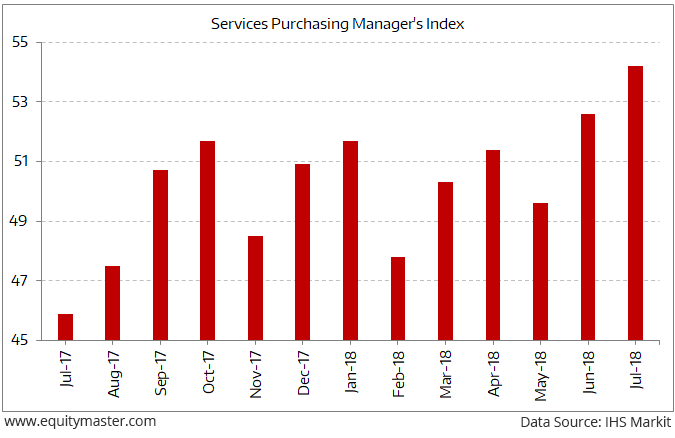
Moving on to news about the economy. India's services sector witnessed expansion in July at its fastest pace in nearly two years on better demand and new business orders.
India's dominant services industry activity showed signs of positivity as new business continued to increase. The country's predominant sector witnessed expansion, with new orders rising due to an improvement in overall operating conditions in the economy, according to the Nikkei Services Purchasing Managers' Index (PMI) survey by Markit.
The Services PMI is the reading of the country's services sector output and is updated monthly. A reading above 50 indicates expansion, while any score below the mark denotes contraction.
A strong rise in new business resulted in monthly increase in activity. The services PMI for July finished at 54.2, from 52.6 in April.
Services PMI Continues to Expand
On the price front, an uncertain global climate, currency weakness and a strong inflation may continue to put pressure on the central bank to hike interest rates over the coming months.
The data comes as the Reserve Bank of India's (RBI's) Monetary Policy Committee hiked repo rate by 25 basis points to 6.5% in its third bi-monthly monetary policy review of 2018-19.
This hike by RBI turns out to be a back to back interest rate increase. In its June policy meet, the rate-setting panel headed by Governor Urjit Patel raised repo rate by 25 basis points to 6.25%. Back then, that was the first rate increase since Narendra Modi came to power in May 2014.
The latest PMI data suggests that the recent surge in the price of oil, India's biggest import item, and a sharp weakness in the rupee will keep risks for inflation remain on the upside.
Moving on to news from . is in focus today after it was reported that the airline will be unable to fly beyond 60 days unless cost-cutting measures including pay cuts are put in place.
It was also reported that the airline has approached investment bankers again to help sell a stake in the carrier.
At the time of writing Jet Airways share price was trading down by 8%.
Air travel has recorded double-digit growth for 45 consecutive months, thanks to low fares, the addition of new flights/destinations, and overall growth in the economy.
What's foreseeable for India's aviation traffic in 2018 is some pressure on the back of the consistent rise in crude oil prices. Earlier this month, Brent crude oil briefly breached US$80 per barrel and touched its highest level since December 2014. Crude prices have been driven up by production curbs in OPEC nations and Russia, as well as by robust demand on the back of healthy global economic growth.
Oil prices are closely monitored by the Indian air carriers, as aviation turbine fuel is their single largest input cost. A sharp rise in the cost of fuel puts pressure on margins, and consequently an increase in air fares.
Although air travel is becoming the new normal, investors need to understand the industry dynamics before buying up aviation stocks.
This article was originally published in English at www.equitymaster.com
Read the complete Indian stock market update. For the terms of use, go here.

Sensex Opens Firm; Realty & Auto Stocks Lead

Asian stock markets are higher today as Japanese and Hong Kong shares show gains. The Nikkei 225 is up 0.1% while the Hang Seng is up 0.2%. The Shanghai Composite is trading up by 0.3%. Meanwhile, technology stocks pushed the S&P 500 and Nasdaq higher on Thursday, driven by Apple shares as the iPhone maker became the first publicly traded US company worth a trillion dollars.
Back home, India share markets have opened the day in green. The BSE Sensex is trading up by 206 points while the NSE Nifty is trading up by 65 points. The BSE Mid Cap index opened and BSE Small Cap index opened the day up by 0.6% & 0.5% respectively.
The rupee is currently trading at 68.36 to the US$.
All sectoral indices have opened the in green with realty stocks and automobile stocks witnessing maximum buying interest.
In the news from the oil & gas sector. In the latest development, ONGC on Thursday reported its highest quarterly net profit in over four-and-a-half-years on sharp rise in prices for oil and gas it produced.
Its net profit of Rs 61.4 billion in the first quarter of the 2018-19 fiscal was 58.1% higher than Rs 38.8 billion in the year-ago period. The net profit is highest since December 2013 when earnings had hit Rs 71.3 billion.

ONGC realised US$71.48 for every barrel of crude oil it produced in the April-June quarter of the current fiscal, up 47.6% over US$48.42 a barrel in the year-ago period.
For natural gas, it got Rs 3.06 per million British thermal unit as compared to Rs 2.48 per mmBtu. ONGC said its crude oil production dropped 5.3% to 5 million tonnes in the quarter. This was partly made up by a 2.5% rise in output from joint venture fields, that pumped 0.8 million tonnes oil.
Natural gas production was however 3.4% higher at 5.9 billion cubic metres. Its revenue from operations rose 42.7% to Rs 272.1 billion for the quarter under review.
Further, ONGC said it deposited Rs 27 billion service tax and GST under protest as it believes such taxes are not applicable on royalty paid by the firm to the government.
Oil producers like ONGC are required to pay 12.5% royalty on crude oil to the state governments for on-land areas and at 10% to the central government for shallow water areas. The tax department is seeking payment of service tax on these royalty payments.
ONGC share price opened the day up by 1.3%.
Moving on to the news from economy. India plans to delay the imposition of retaliatory duties on US goods, the trade ministry said on Thursday, to allow time to resolve disputes that worsened after President Donald Trump imposed tariff hikes on steel and aluminium.
The move comes at a time when the US on Monday elevated India's status by placing it in the Strategic Trade Authorization (STA) Tier 1 list-comparable to North Atlantic Treaty Organization (Nato) allies-that eases export of high-tech defence items to it without individual licenses.
On Wednesday, the US Congress amended an Act that will provide waiver to India and other allies from sanctions if they conduct strategic defence purchases from Russia.
In June, New Delhi, incensed by Washington's refusal to exempt it from these new tariffs, announced it would raise import tax on some US products including almonds, walnuts and apples.
Reportedly, the government had proposed to put the new tariffs, which were due to go into effect on 4 August.
Note that, trade differences between India and the United States have been rising since Trump took office.
Bilateral trade rose to US$115 billion in 2016, but the Trump administration wants to reduce its US$31 billion deficit with India, and is pressing New Delhi to ease trade barriers.
Notably, the country's steel industry was just coming out of a rough patch.
Demand was picking up. Steel prices were on the rise. Buyers were lining up to pick up stressed assets. With the expected pick up in the investment cycle, the sector was on the upswing.
India's Steel exports were on a roll.
Is the Steel Sector's Recovery Under Threat?
Then Donald Trump spoiled the party. The US government plans to impose a 25% tariff on steel and a 10% tariff on aluminium.
India produces a lot of both commodities but internationally, we are not a big player. The US imports only 2.4% of steel and 2% aluminium from India.
Co-head of Research & editor of StockSelect at Equitymaster, Tanushree Banerjee, wrote about the trade war a few months back. Here's what she said:
  • Trade wars can cause short-term pain. But it can't change the long-term trend of the market. Only earnings can do that.

    Back in India, we too have suffered a lot; wars, droughts, riots, terrorism, corruption, corporate frauds, political assassinations, multiple government changes, failed economic policies...

    But corporate earnings have grown by about 15% annually and the BSE Sensex has delivered about 15% annualised over the long-term.

    That's the important thing. I'll never tire of repeating it.

    In the long-term, only earnings can drive stock prices.
This is true.
During times like these, the best thing you can do is to identify stocks that can ride out the storm.
This article was originally published in English at www.equitymaster.com
Read the complete Indian stock market update. For the terms of use, go here.

Thursday, 2 August 2018

Sensex Trades 200 Points Down; Bharti Airtel & Kotak Mahindra Bank Fall

Stock markets in India are trading lower today post the 25-bps rate hiked by the Reserve Bank of India (RBI) on Wednesday. Losses are largely seen in realty stocks and automobile stocks.
The BSE Sensex is trading down by 200 points and the NSE Nifty is trading down by 58 points. Meanwhile, the BSE Mid Cap index is trading up by 0.6% while, the BSE Small Cap index is trading up by 0.2%. The rupee is trading at 68.61 to the US$.
In news from the automobiles sector. As per an article in a leading financial daily, Tata Motors has registered an impressive growth of 21% in its domestic sales at 51,896 units in July 2018, as against 42,775 units over last year.
The growth came on the back of continued strong sales performance of its Commercial and Passenger Vehicles Businesses in the domestic market.
Tata Motors' Commercial Vehicles domestic sales in July 2018 were at 34,817 units, an increase of 25%. The M&HCV truck segment continued its significant growth momentum with 10,233 units, an increase of 18% over last year.
Tata Motors' Passenger Vehicles domestic sales in July 2018 were at 17,079 units a growth of 14%, over last year. The company's sales from exports (from CV and PV) in July 2018 stood at 4,971 units as against 3,441 units, registering a growth of 44% over last year.
At the time of writing, Tata Motors' share price was trading flat.
In the news from the economy. Revenue collection under the Goods and Services Tax (GST) during the month of July 2018 increased to Rs 964.8 billion, as compared to previous month's revenue collection of Rs 956.1 billion, on the back of improved compliance of the e-way bill, which has been made mandatory for moving goods worth over Rs 50,000 from one State to another.
According to the Finance Ministry data, out of the Rs 964.8 billion, Central GST (CGST) was Rs 158.8 billion, State GST (SGST) Rs 222.9 billion, Integrated GST (IGST) Rs 499.5 billion (including Rs 248.5 billion collected on imports) and cess Rs 83.6 billion.
It added that this is broadly on expected lines. It also noted that as many as 66 lakh businesses filed returns in the month of July, making it the highest number of monthly GSTR-3B filed since the rollout of GST in July last year.
The Ministry has stated that despite a rise in revenue collection in July, the mop-up is still lower than the government's monthly target of Rs 1 trillion. The 2018-19 budgeted estimate for GST collection is Rs 12 trillion.
Note that GST implementation is spurring on a wave of formalization of the economy.
Since the launch of Goods and Services Tax (GST), there were 9.8 million unique GST registrants, an increase of 50% compared to the previous tax regime. There has also been a large increase in voluntary registrations, especially by small enterprises that buy from large enterprises wanting to avail themselves of input tax credits.
A Large Increase in Registered Indirect and Direct Taxpayers
Similarly, after November 2016, 10.1 million tax filers were added compared to an average of 6.2 million in the preceding six years. Further analysis suggests that new filers reported an average income, in many cases, close to the income tax threshold of Rs. 2.5 lakh, limiting the early revenue impact. As income growth pushes many of the new tax filers in time over the threshold, the revenue dividends should increase robustly.
These changes can have profound effects on the Indian economy. With the increasing tax base, the government will have a significant amount of resources to spend on infrastructure, health and education, While the fiscal deficit will be stable.
As organized players gain market share, it will begin to reflect in corporate earnings and stock prices too.
To know what's moving the Indian stock markets today, check out the most recent share market updates here.
This article was originally published in English at www.equitymaster.com
Read the complete Indian stock market update. For the terms of use, go here.

DILIP BUILDCON LTD Surges by 6%; BSE CAPITAL GOODS Index Up 0.5%

DILIP BUILDCON LTD share price has Zoomed 6% and is presently trading at Rs 843.
Meanwhile, the BSE CAPITAL GOODS Index is at 18,365 (Up 0.5%).
Among the top Gainers in the BSE CAPITAL GOODS Index today is DILIP BUILDCON LTD (up 6.3%).
SADBHAV ENGINEERING (down 0.4%) and HAVELLS IND (down 0.5%) are among the top losers today.
Over the last one year, DILIP BUILDCON LTD has moved up from Rs 527 to Rs 843, registering a gain of Rs 316 (up 60.0%).
On the other hand, the BSE CAPITAL GOODS has moved up from 17,906 to 18,365, registering a gain of 459 points (up 2.6%) during the last 12 months.
The top gainers among the BSE CAPITAL GOODS Index stocks during this same period were GRAPHITE INDIA (up 410.2%), HAVELLS IND (up 35.0%) and THERMAX LTD (up 32.4%).

What About the Benchmark Indices?

The BSE Sensex is at 37,530 (up 0.0%).
The top gainers among the BSE Sensex stocks today are ONGC (up 1.8%), COAL INDIA (up 1.4%) and POWER GRID (up 0.8%). Other gainers include VEDANTA LTD (up 0.5%) and INDUSIND BANK (up 0.5%). The most traded stocks in the BSE Sensex are INDUSIND BANK and AXIS BANK.
In the meantime, NSE Nifty is at 11,329 (down 0.2%). HPCL (up 1.6%) is among the top gainers in NSE Nifty.
Over the last 12 months, the BSE Sensex has moved up from 32,575 to 37,530, registering a gain of 4,955 points (up 15.2%).
This article was originally published in English at www.equitymaster.com
Read the complete Indian stock market update. For the terms of use, go here.

Wednesday, 1 August 2018

Sensex Opens Day in Red; Auto Stocks Top Losers

Asian share markets are mixed today as Chinese and Japanese shares fall. The Nikkei 225 is down 0.6% while the Hang Seng is down 2.3%. The Shanghai Composite is trading down by 2.5%.
Back home, India share markets opened the day on a negative note. The BSE Sensex is lower by 220 points while the NSE Nifty is trading down by 70 points. The BSE Mid Cap index and BSE Small Cap index both opened the day down by 0.5% & 0.3% respectively.
In news from the global economy. Following the Reserve Bank of India's decision to hike key interest rates by 25 basis points (bps), the US Federal Reserve held its rates steady while reiterating their plan to gradually lift borrowing costs to keep the economy expanding at a healthy pace.
Federal Reserve Chairman Jerome Powell is trying to nurture the second longest U.S. expansion on record by slowly reducing the amount of support that monetary policy provides to growth.
The US economy is riding a tailwind from tax cuts and higher federal spending, though a trade war threatens to dent growth.
Tracking the US Fed announcement, the yield on the benchmark 10-year U.S. Treasury note broke above 3% for the first time since June after the government said it intended to increase its borrowing from the bond market in the coming quarter to fund spending and debt obligations.
This Chart Has the Key to Your Future Stock Market Returns
One of the key determinants of liquidity flows in the stock markets is interest rates. The 10-year US Treasury bond is a global interest rate benchmark.
The prolonged artificial suppression of interest rates and money printing by the US Fed, flooded the global financial markets with cheap liquidity and lifted stock prices to frothy levels.
In fact, at the recent shareholder meeting of Berkshire Hathaway, Charlie Munger did make a reference to this condition:
  • Low-interest rates are unfair to old savers, but favourable to Berkshire Hathaway's shareholders sitting here. We are all a bunch of undeserving people and hope we continue to be so.
Now, just the way lower interest rates can fuel stock market rallies, the vice-versa is also true. If interest rates start firming higher, it can play spoilsport to the unbridled global stock market bull run.
In fact, the market correction we witnessed in February-March this year can be attributed to the rising yield on the 10-year US Treasury bond.
In a note to his Insider readers at the end of January 2018, Ankit Shah, Research Analyst, had raised a warning flag about the rising yields on the benchmark 10-year US Treasury bonds.
With bond yields now breaching the 3% mark, and the Fed in the process of shrinking its balance sheet, you cannot expect the flood the liquidity to keep lapping up stock prices.
If interest rates go up further, foreign investors will either go slow on India or exit all together.
So, be careful. Don't take the abnormally high valuation multiples as the new normal. At the same time, don't exit the markets out of panic.
Moving on to news from stocks in the engineering sector. Larsen & Toubro (L&T) share price is in focus today after the company said that it plans to undertake an offer for sale (OFS) of L&T Technology Services' shares. The OFS will open for non-retail investors today, and for non-retail investors on Friday.
L&T plans to sell over 4.1 million shares of L&T Technology Services as part of the base offer, and additional shares up to 2.5 million shares in case of oversubscription.
The company has set a floor price of Rs 1,400 per share. L&T Technology Services share price is currently trading at Rs 1,440 levels after it opened the day down by 4%.
Currently, the promoters hold an 87.1% stake in the company. If the offer is fully subscribed, Larsen and Toubro's stake in L&T Technology Services will fall to 77.5%. The company said if the oversubscription option is exercised the stake may fall further to 75.1%.
The OFS will help the company meet the market regulator's minimum public holding norm.
L&T share price opened the day down 0.3%.
This article was originally published in English at www.equitymaster.com
Read the complete Indian stock market update. For the terms of use, go here.