Friday, 12 January 2018

Indian Indices End at Fresh Record High; Energy Stocks Witness Buying

After trading on a volatile note in the afternoon session, Indian share markets witnessed buying interest at the end of the day and ended their session at a fresh record closing high. Losses were largely seen in the FMCG sector and realty sector, while energy stocks ended the day higher.
At the closing bell, the BSE Sensex stood higher by 89 points (up 0.3%) and the NSE Nifty closed higher by 30 points (up 0.3%). The BSE Mid Cap index ended the day down by 0.2%, while the BSE Small Cap index ended the day up by 0.1%.
Asian stock markets finished mixed as of the most recent closing prices. The Hang Seng was up 0.94%, while the Nikkei was trading down by 0.24%. The Shanghai Composite stood higher by 0.12%. The rupee was trading at 63.64 to the US$ at the time of writing.
In the news from the GST space, as per an article in the Economic Times, India is set to unveil another revamp of the goods and services tax (GST) regime next week aimed at making the compliance simpler.
The upcoming GST Council meeting on January 18 is said to take up changes in the definitions of terms such as supply and handicrafts besides replacing the three forms that need to be submitted with one.
The Council is also expected to drop the requirement for upfront invoice matching.
The above development would be the second significant overhaul of GST after a November rejig that saw the tax rate on 178 household goods being lowered.
Notably, the above developments will lead to easier compliance and also simplify processes, both of which would lead to smooth implementation of GST. We will keep you updated on all the recent developments in this space. Stay tuned.
After studying these and other finer aspects of GST, our colleague Vivek Kaul, has penned his views on what could go right and wrong. The report is titled The Good, the Sad and the Terrible (GST). Claim your own copy of his special report now.
In the news from the commodity space, gold is continuing its weekly momentum and is trading on a positive note today.
Most of the gains for the yellow metal are seen on the back of a weaker dollar overseas and a firm trend in precious metals.
While the recent gains notable, returns from gold over the past few years have been anything but flattering. Mainly a hedge against market volatility, gold prices have remained at roughly the same levels since 2013, as can be seen in the chart below:
Gold Returns : 2013 - 2017
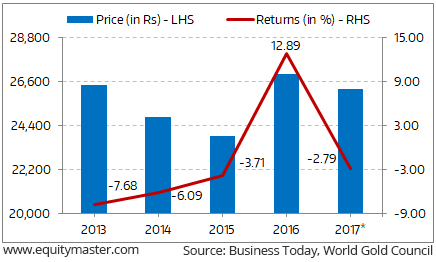
On the contrary, share markets in India have been on a constant upward trajectory during the same period. The only blip seen was in 2016, when gold prices gave healthy returns.
One reason for the lackluster returns has been the global economy. US interest rates have been on the rise since 2014. This has swayed investors' interest towards government bonds, subsequently reducing demand for gold.
While the US Federal Reserve is also expected to raise interest rates next year, current gold valuations seem to have factored that in.
Certain political developments also warrant a look-in at gold. Rising tensions between US and North Korea and slowdown in Middle-east have been recent concerns. Also, it provides a hedge against markets which are touching new highs every day.

And here's a note from Profit Hunter:

The Nifty 50 Index traded on a positive note during the week. On Monday, it opened the session 58 points gap up at a new life-time high and continued to trade higher. It then traded in a narrow range for the next three sessions. Finally, on Friday, the Nifty index opened 32 points gap up and continued the positive momentum to end its weekly session 1% up.
Last week, we saw the index finding support from 10,500 level. The level which acted as a strong resistance on the way up will now act as a strong support for the index as per the change of polarity principle.
The index is currently trading in the uncharted territory. Now how long it maintains the bullish momentum will be an interesting thing to watch out for in the week to come.
Nifty 50 Index Ends at Life-time High
This article was originally published in English at www.equitymaster.com
Read the complete Indian stock market update. For the terms of use, go here.

Sensex Trades in Red; Realty Stocks Top Losers

After opening the day on a positive note, Indian share markets witnessed selling pressure and are currently trading in red. Sectoral indices are trading mixed, with stocks in the realty sector and stocks in the IT sector witnessing maximum selling pressure.
The BSE Sensex is trading down by 85 points (down 0.3%) and the NSE Nifty is trading down 36 points (down 0.3%). Meanwhile, the BSE Mid Cap index is trading flat, while the BSE Small Cap index is trading up by 0.3%. The rupee is trading at 63.56 to the US$.
In news from stocks in the IT sector. Tata Consultancy Services (TCS) share price is in focus today after the IT major bagged a US$ 2 billion deal from US insurance group Transamerica.
India's largest IT firm, TCS said that it bagged a multi-year agreement with Transamerica, and that the agreement will bring in more than US$ 2 billion in revenues. TCS added that the agreement is expected to be completed by the second quarter of 2018.
The announcement comes a day after TCS reported a 3.6% fall its net profit to Rs 65.3 billion in the December 2017 quarter. The IT bellwether had posted a net profit of Rs 67.8 billion in the December quarter of the previous financial year.
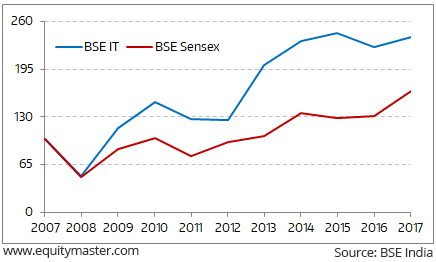
BSE IT Index vis-a-vis Sensex
The Indian information technology (IT) sector has been through the doldrums over the past few years. IT giants have seen flat to negligible growth in the past 3-4 years. However, going by the IT index performance in the past few months, there seems to be some fight left in the IT space.
This is in stark contrast to its performance over the past four years. The Indian IT Index has returned a meager 19% returns as compared to Sensex returns of 58% since 2013.
The sector has seen a major disruption in the business model. The shift from traditional IT services like application maintenance to analytics, cloud computing has hurt growth for almost all major IT companies.
As a result, major Indian IT companies are trading at multi-year low valuations. Also, IT companies are moving towards an efficient business model whereby manpower for mundane tasks are being replaced by automation. It will be an interesting space to watch out for in the days ahead.
Moving on to news from the automobile sector. According to a leading financial daily, The Delhi Government plans to switch all the vehicles in the capital region to electric in the next 20 years. The government's deputy chief minister said that the state government is working with the centre to attain electric mobility.
Delhi plans to launch a bus terminal that will run 100% on electric mode.
Government think-tank Niti Aayog has outlined a vision to shift 100% of commercial vehicles used for intra-city transport and 40% of personal vehicles to an all-electric mode by 2030.
Currently, electric vehicle sales are low in India, rising 37.5% to 22,000 units in the year ended 31 March 2016 from 16,000 in 2014-15. Only 2,000 of these were cars and other four-wheelers, according to automobile lobby groupSociety of Indian Automobile Manufacturers (Siam).
The government wants to see 6 million electric and hybrid vehicles on Indian roads by 2020 under the National Electric Mobility Mission Plan 2020.
The government is targeting to have all cars propelled by electric engine by 2030. The target is more daunting than in many advanced countries.
According to the industry, the 2030 target would require eight to ten times the global stock of such vehicles. India would need to sell more than 10 million electric cars in 2030, compared to 5,000 electric vehicles India had on the road in 2016.
Another issue is the price of the lithium ion battery, which constitutes 30% to 40% of the cost of the car. For this plan to succeed, the price of the battery needs to come down.
The auto industry is already facing regulatory headwinds. The shift from BS-IV emission norms to BS-VI has been two years ahead of schedule without an intermediate stage. The government, if it is serious about such ambitious targets, should offer the necessary infrastructure support and do its bit for a smooth transition.
This article was originally published in English at www.equitymaster.com
Read the complete Indian stock market update. For the terms of use, go here.
Thursday, 11 January 2018

Sensex Opens Firm; Metal Stocks Gain

Asian stock markets are higher today as Japanese and Hong Kong shares show gains. The Nikkei 225 is up 0.05% while the Hang Seng is up 0.49%. The Shanghai Composite is trading up by 0.04%. Meanwhile, The Dow Jones industrial average rose to an all-time high on Thursday as investors bet economic growth would pick up steam.
Back home, India share markets opened the day on a strong note. The BSE Sensex is trading higher by 110 points while the NSE Nifty is trading higher by 37 points. The BSE Mid Cap index and BSE Small Cap index opened the day up by 0.4% & 0.6% respectively.
All sectoral indices have opened the day in green with metal stocks and energy stocks witnessing maximum buying interest. The rupee is trading at 63.74 to the US$.
2017. What a year this has been for equity investors. The BSE Sensex is trading close to 34,000 mark. The Nifty is trading above 10,500 levels.
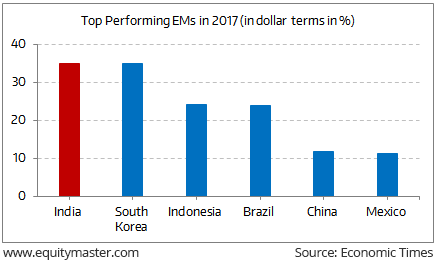
India was among the three emerging markets, which gained more than 35% in dollar terms. The other two are Hungary and South Korea.
India Outperforms Emerging Market Peers in 2017
The BSE Sensex earned a 35.1% return in the dollar terms and 28% in the local currency in 2017. However, this wasn't enough to beat the midcap and smallcap indices. The midcap and smallcap indices saw a sharp increase of 47% and 58% respectively in 2017.
With this, the market cap to GDP ratio is close to 100%, indicating market at its peak. So, how will 2018 turn out? Here's what Tanushree Banerjee, Co-head of Research thinks:
  • "In 2018, the market would be more volatile and under pressure. Investors should brace themselves for the increasing volatility. Although, earnings are likely to recover, profit margins could get squeezed as companies face rising input cost pressures. Rising oil prices may prompt the government to abandon fiscal prudence at a time when GST collections have been lower than expected.

    2018 will, therefore, be critical for Indian companies to justify their valuations with earnings growth. If the earnings growth does not materialize, correction could be on the cards."
TCS share price fell 1.2% in the opening trade after the company posted December quarter revenue growth that fell short of already downbeat Street expectations, as it battled headwinds in the US and soft demand from financial services clients. TCS net profit fell 3.6% to Rs 65.3 billion in the December 2017 quarter as compared to Rs 67.8 billion in the October-December quarter of the previous fiscal.
Bank stocks have opened the day on a mixed note with Bank of India and SBI being the most active stocks in this space. At a time when rating agencies have flagged concerns over the rising delinquencies in the affordable housingsegment, State Bank of India (SBI) on Thursday said it plans to raise Rs 200 billion through long term bonds to fund affordable housing.
Reportedly, a proposal will be submitted to executive committee of central board (ECCB) for approval for issuance of long-term bonds of Rs 200 billion for financing of infrastructure and affordable housing in domestic and overseas market instead of Rs 50 billion intimated earlier.
Earlier this week, SBI had announced plans to raise up to US$2 billion by issuing bonds in US dollar or other convertible currency to fund overseas expansion.
It said the fund-raising will take place through a public offer and/or private placement of senior unsecured notes in US dollar or any other convertible currency during 2017-18 and 2018-19.
Last month, SBI board had approved raising of Rs 80 billion through various sources, including masala bonds, to meet Basel III capital norms. Masala bonds are rupee denominated specialised debt instruments that can be floated in overseas markets only to raise capital. The bank said it has time till March 2018 to raise the funds.
One shall note that, banks in India have to comply with the global capital norms under Basel III by March 2019. Internationally agreed timeframe for the same is January 2019.
SBI share price opened the day up by 0.6%.
Moving on to the news from oil & gas sector. As per an article in a leading financial daily, Indian Oil Corporation (IOC) bought its third shipload or cargo of US crude oil as it looks at cheaper alternatives that have emerged due to the global supply glut.
Reportedly, IOC bought 2 million barrels of light Louisiana sweet crude oil in a tender. The oil is for delivery at its Paradip refinery in Odisha during 11-20 April.
IOC's Paradip refinery had in October last year received India's first ever shipment of US crude oil when it imported a 1.6 million barrels parcel.
Further, Bharat Petroleum Corporation Limited (BPCL) and Hindustan Petroleum Corp Limited (HPCL) had also placed orders for about 2.95 million barrels and 1 million barrels of US crude respectively for their Kochi and Visakhapatnam refineries recently.
The October cargo was the first shipments to India since the US stopped oil exports in 1975.
IOC's first purchase of US crude comprised 1.6 million barrels of high sulphur crude Mars and 400,000 barrels of Western Canadian Select oil. In the second, it bought 1.9 million barrels of US crude, half of it being shale oil.
The second shipment was for the west coast.
India, the world's third-largest oil importer, joins Asian countries like South Korea, Japan and China to buy US crude after production cuts by oil cartel OPEC drove up prices of Middle East heavy-sour crude, or grades with a high sulphur content.
Notably, buying US crude has become attractive for Indian refiners after the differential between Brent (the benchmark crude or marker crude that serves as a reference price for buyers in the western world) and Dubai (which serves as a benchmark for countries in the east) has narrowed.
IOC share price opened up by 1.2%.
This article was originally published in English at www.equitymaster.com
Read the complete Indian stock market update. For the terms of use, go here.
Sensex Ends Higher; Infosys & Bharti Airtel Top Gainers

After opening the day on a flat note, Indian share markets ended the day marginally higher. At the closing bell, the BSE Sensex finished higher by 70 points. While, the NSE Nifty finished higher by 23 points. Meanwhile, the S&P BSE Midcap Index ended up by 0.3% while S&P BSE Small Cap Index ended up by 0.4% respectively.
Sectoral indices ended the day on a mixed note with realty stocks and information technology stocks leading the gainers. While, energy stocks and consumer durables stocks ended the day in red.
Overseas, Asian stock markets finished mixed as of the most recent closing prices. The Hang Seng gained 0.15% and the Shanghai Composite rose 0.10%. The Nikkei 225 lost 0.33%. European markets are mixed. The CAC 40 is higher by 0.03%, while the DAX is leading the FTSE 100 lower. They are down 0.13% and 0.12% respectively.
The rupee was trading at Rs 63.74 against the US$ in the afternoon session.
In the latest development, India's securities regulator has banned the global accountancy firm PwC from auditing listed companies in the country for two years, after it failed to spot a US$1.7 billion fraud at the defunct Satyam Computer Services.
Reportedly, PwC had neglected to check "glaring anomalies" in the financial details reported by Satyam, whose downfall followed one of the worst financial scandals in Indian corporate history.
For about five years beginning in 2003, Satyam inflated its revenue by accounting for 7,561 fake invoices. The fraud persisted in part because PwC, Satyam's auditor, did not independently check the veracity of the monthly bank statements.
As well as the auditing suspension, the regulator ordered PwC to disgorge wrongful gains of about Rs 130 million.
The order comes nine years after the scam at Satyam Computer Services first came to light and after two failed attempts by PwC to settle the case through the consent mechanism.
One shall note that, Satyam was sold in 2012 to rival Tech Mahindra, which dropped the company's brand. Mr. Raju received a seven-year jail sentence in April 2015, one of four Satyam executives to be convicted in connection with the fraud.
Notably, there are some stocks out there that are suffering from what Tanushree Banerjee, Co-head of Research at Equitymaster calls Satyam-itis.
As per her, Satyam-itis is a deadly ailment that promises to wipe out wealth before you know it. And there are several that show symptoms of Satyam-itis... Here's an excerpt of what she wrote:
  • "...Obtuse financial statements, lack of business consistency, repeated "restructuring", fancy earnings guidance and a maze of related party transactions that must raise the red flag...

    Instead, ignorance about them have led readers to believe that such stocks could compete with bitcoins.

    But every few years there is an Enron or a Satyam that teaches new investors some very old lessons...when it comes to the markets, put safety-first.

    So, whether it's your stocks or your bitcoins - make sure they aren't suffering from Satyam-itis."
In such an environment, it makes sense for investors to be selective while buying stocks. Focus on value and the underlying fundamentals of the business..
So, what is key to identifying potential multibagger stocks? How does one pick them at the right time and ride them to their full potential? How many multibaggers do you really need to achieve the big riches that you desire?
Most importantly, are there any stocks right now that could turn out to be multibaggers? Click here to know everything that you need to know right now about mutlibagger stocks...
In another development, credit rating agency, ICRA in its latest report has said that Indian tyre industry revenues is likely to grow by 8% during the current financial year (FY18), on the back of favorable demand prospects along with price hikes between January-May 2017.
As per the report, the industry is expected to witness growth in volumes as well at the rate of 8% to record 1,805 lakh tyres during FY18, despite the weak volumes in Q1 and part of Q2 during GST roll-out.
In the terms of tonnage, tyre demand is estimated to grow by 7% during the current financial year, on the back of increased T&B replacement demand.
The rating agency also pegged growth rate of 8.5% and 7% to the unit and tonnage, respectively for the next fiscal year.
Besides, ICRA estimated that the tyre industry will grow at the rate of 10% during FY18-22 and during the same period, the industry will fund their heavy capex with the help of past three years' significant accruals.
It further noted that the industry will continue adding capacity over next five years, owing to the large cash balances, strong accrual position and favourable demand. As per report, capex investments are likely to continue with planned Rs 250 billion of investments spread across the next five years.
Meanwhile, government has successfully divested 2.52% of paid-up capital in National Mineral Development Corporation (NMDC) for an amount of around Rs 12 billion (Rs 9.8 billion from non-retail investors and around Rs 2.3 billion from retail investors) through Offer for sale (OFS) mechanism.
With this transaction, the Government of India shareholding in NMDC has come down from 74.9% to 72.4%.
One shall note that, the government has already raised Rs 538.3 billion through disinvestment in public sector firmsthis fiscal by listing public sector insurers and exchange traded fund.
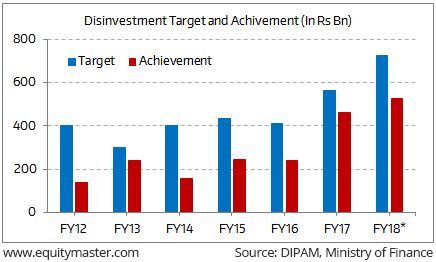
For the current fiscal year, it has set a target of raising Rs 725 billion via disinvestment, which includes Rs 465 billion through minority stake sales, Rs 150 billion from strategic sale and another Rs 110 billion from listing of insurance firms.
Higher Revenue from Disinvestment?
It will be interesting to see how the government approaches disinvestment in the coming months.
Speaking of disinvestment, a lot of PSUs have had history of bad management by the government and have reached a point of no return when it comes to profitability. The accumulated losses of sick public sector enterprises as of 31 March 2014, stood at Rs 1.04 trillion.
But this is just part of the story.
In Vivek Kaul's latest book, India's Big Government-The Intrusive State and How It is Hurting Us, he has exposed the big government's lies. And I'm sure you would want to know the full story as this affects your money and wealth.

And here's a note from Profit Hunter:

The Q3FY18 results seasons are on. And two major results in the IT sector, TCS and INFY, are being scheduled in the next 24 hours. Today, INFY is up 2% with healthy volumes ahead of its quaterly results.
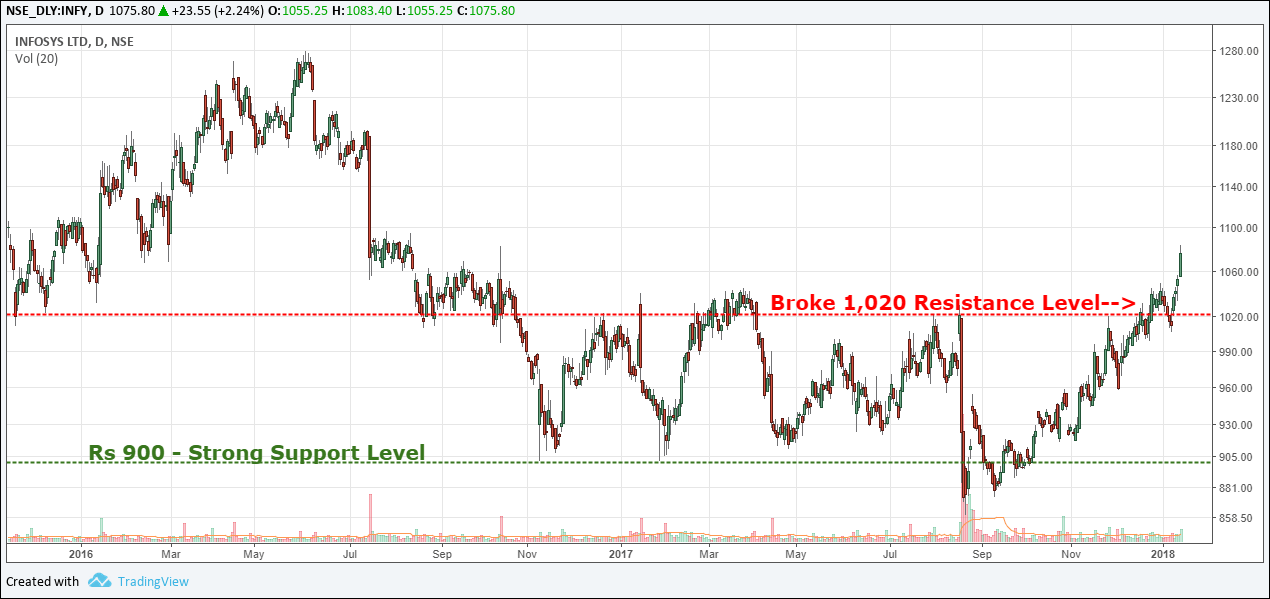
We have reviewed INFY quite a few times in the past. And we have been telling that the stock is trading in a broad range of 900 -1,020 since October 2016. The 1,020 level acted as a strong resistance while 900 level acted as a strong support for the stock.
Few days back, the stock broke above the 1,020 resistance level. This indicates strength in the counter. It slipped back into the range but recovered strongly and now it is trading at a new 52-week high. Stocks usually tend to outperform after they achieve a new 52-week high. To know more read here (subscription required).
Tomorrow, INFY will be announcing it Q3FY18 results. So will the quaterly result add to the rally or will it be a hindrance. Let's wait and watch...
INFY at a New 52-week High

This article was originally published in English at www.equitymaster.com
Read the complete Indian stock market update. For the terms of use, go here.